
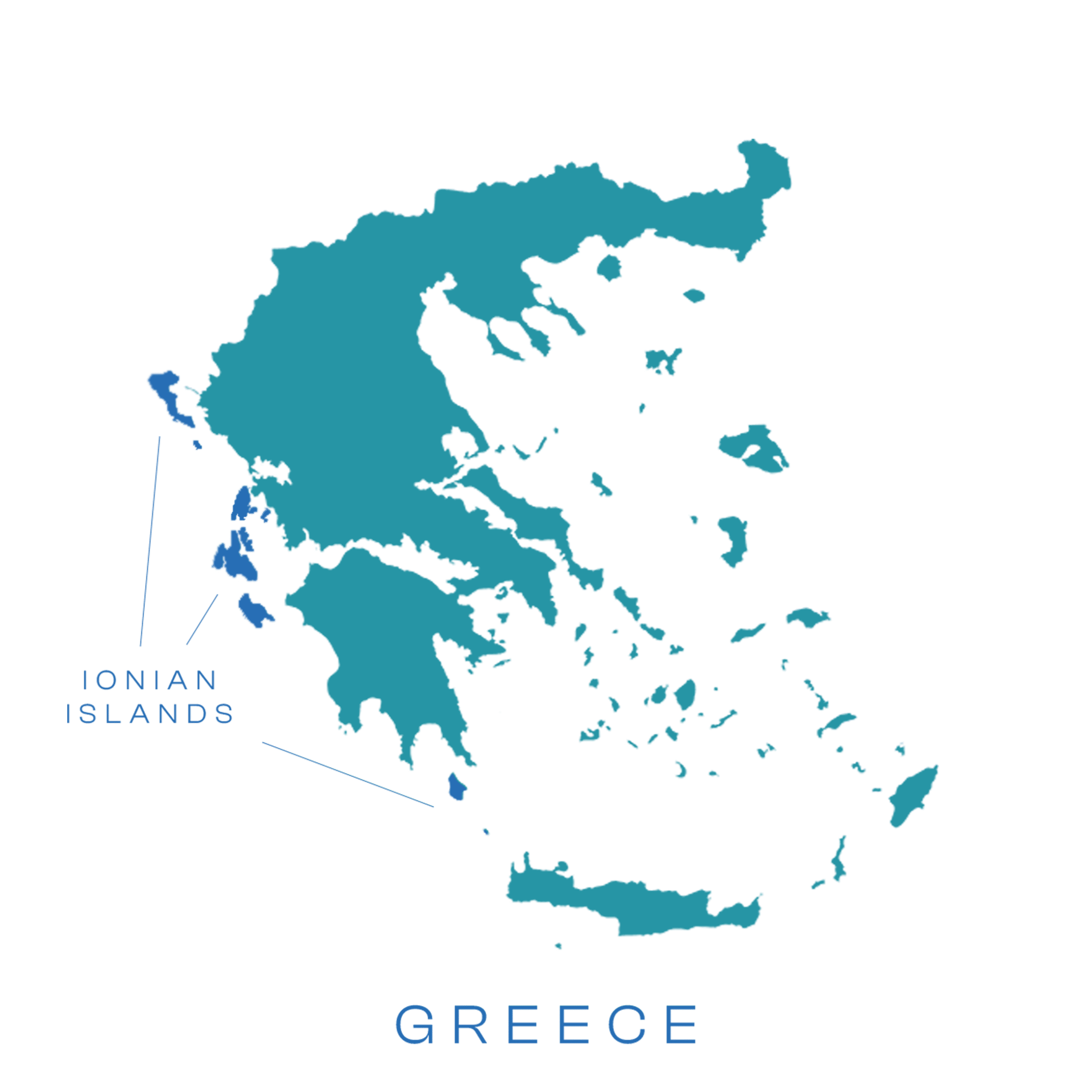
Ionian Islands
The Ionian Islands, also known as Eptanissa, meaning “seven islands,” located off the west coast of Greece, are renowned for their lush landscapes, mild Mediterranean climate, and rich wine-growing heritage.
Wine production in the region dates back more than 2,500 years, with historical references to the wines of Kefalonia and Corfu appearing in Homer’s epics. Today, the Ionian Islands produce a diverse range of wines, primarily from indigenous grape varieties, reflecting the unique terroirs of each island.


Grape varieties and key styles
Native white grape varieties
- Robola – Kefalonia’s flagship white grape variety, producing dry, aromatic wines with high acidity, a mineral character, and notes of citrus and green apple.
- Tsaousi – A traditional table and wine grape variety from Kefalonia, with aromas of lemon and honey and subtle spicy notes.
- Moschatella – Exclusive to Kefalonia, it offers a light muscat aroma with no connection to the muscat family.
- Muscat of Kefalonia – It produces fragrant and floral wines that are both dry and sweet.
- Zakynthino (Pavlos) – A white grape variety found in Zakynthos and
- Kefalonia, it brings freshness and aromatic complexity.
- Skiadopoulo – The basis of the traditional Verdea PGI appellation in
- Zakynthos, it produces typical, aromatic and lively wines with good structure and aging potential.
- Goustolidi (Vostilidi) – A rare grape variety from Kefalonia and Zakynthos, it brings citrus, mineral, and herbaceous notes and is an important component of traditional Verdea wines.
Native red grape varieties
- Mavrodaphne – Important for Kefalonia’s sweet fortified PDO style. Some winemakers produce dry Mavrodaphne, creating one of the island’s most captivating reds, although it is currently illegal to indicate the grape variety on the label of dry wines.
- Vertzami – Lefkada’s dominant red grape variety, known for its almost black color and aromatic intensity, producing medium-bodied wines with traditional purity.
- Avgoustiatis, Katsakoulis, Karabraimis – Minor local red grape varieties adding character and complexity to the region, often used in blends.

Notable areas
Kefalonia
Mountainous and fragmented, with approximately 792 hectares of vineyards. The island is home to more than forty indigenous grape varieties, reflecting Venetian, French, and Italian influences. Robola thrives on the limestone slopes of Mount Aenos, historically known as “vino di sasso” (stone wine). Other notable white varieties include Tsaousi, Moschatella, Kefalonian Muscat, and Goustolidi. Mavrodaphne dominates the island’s red wine profile, with some producers experimenting with dry styles.
Zakynthos
Produces aromatic white wines and structured red wines, mainly from the Skiadopoulo, Zakynthino, and Goustolidi grape varieties.
Corfu
Vineyards are distributed according to soil and topography: reds in the north on heavier soils and whites in the south on coarser soils near sea level. The main grape varieties are white Kakotrigis and red Petrokoritho.
Lefkada
Dominated by Vertzami, it produces deeply colored, medium-bodied red wines with strong aromatic intensity and traditional purity.

Wine heritage
With a winemaking history dating back more than two millennia, the Ionian Islands focus on indigenous grape varieties, preserving local traditions and producing wines that reflect their unique terroirs, from the mineral Robola of Kefalonia to the aromatic Tsaousi, Moschatella, Muscat, and Goustolidi, to Skiadopoulo and Zakynthino from Zakynthos, Vertzami from Lefkada, Kakotrigis and Petrokoritho from Corfu, and the innovative dry Mavrodaphne.

Producers
in this region


